
Sunday Zillows
Michelle Blade’s “It’s About Time” at Night Gallery

Michelle Blade’s “It’s About Time” at Night Gallery
April 18 - May 23, 2026
2 Stars
Michelle Blade is part of the trend which I wrote about in a previous review. I called it California Lifestyle Art. This genre of art includes the painters Jonas Wood, Hayley Barker, Bella Foster, Hillary Pecis, and a number of similar, less famous painters who tend to depict, primarily, the possessions, houses, and interiors of a certain class of people. An art writer I know suggested that this might be an international tendency and that International Lifestyle Art might be a better moniker. Fair point, but CLA (as I’ll call it) seems particularly ubiquitous here in LA. Not that other variants don’t exist. The California strain, however, tends to be defined by local plant-life and real estate; it stands to reason that it is, at surface level, “local” even if this lifestyle image has international reach. Likewise, most of these artists have exhibited internationally and, in some cases, lived in New York. Nevertheless, for whatever reason, I prefer to frame these things narrowly.
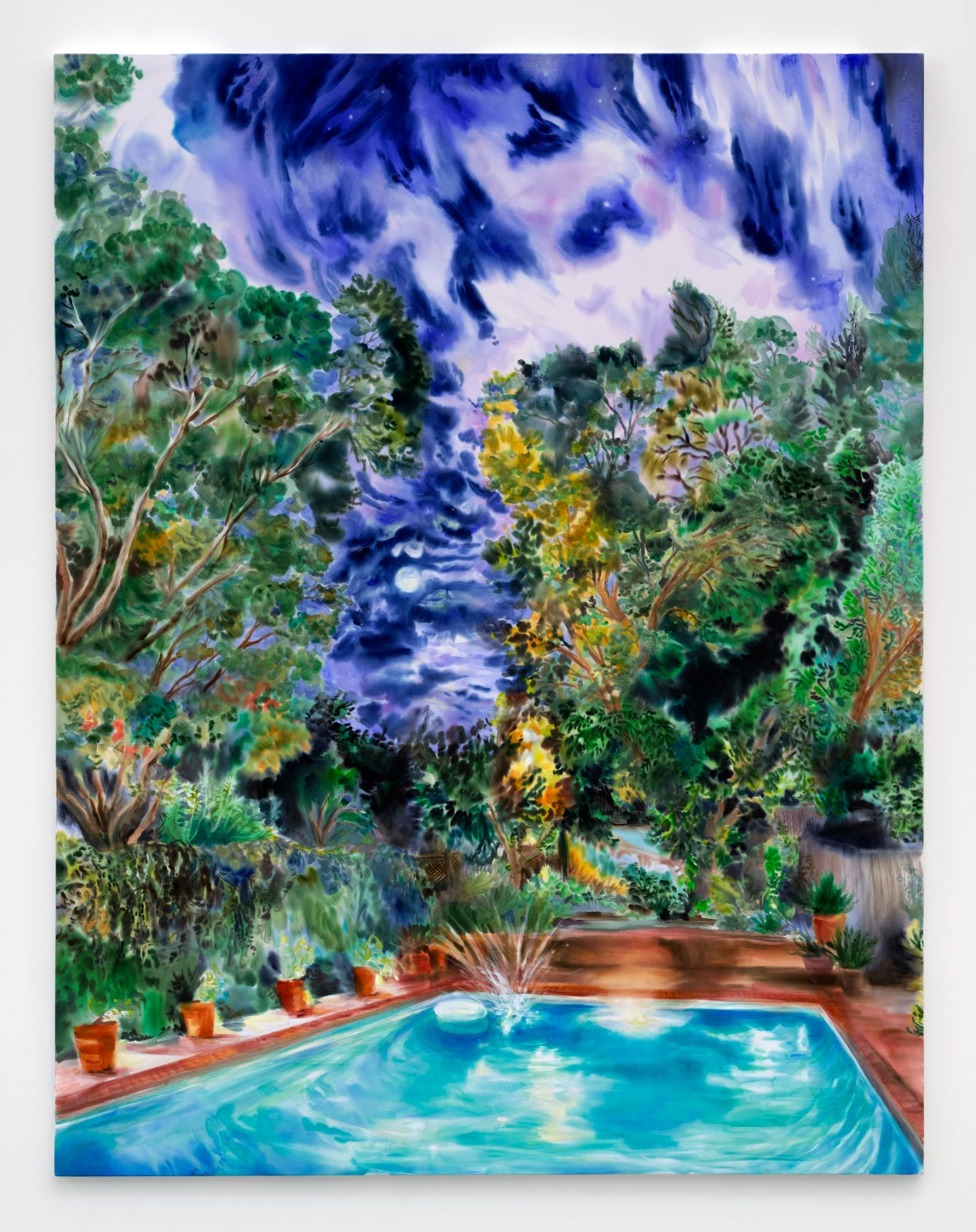
CLA has some defining characteristics. These artists tend to represent fashionable interiors, generally tending toward a millennial aesthetic, with mid-century Modern furniture—one which tends toward the spare but nominally cozy as opposed to the more austere presentations of interior design magazines. Plant-life is a preponderant motif, generally in the form of palm fronds, succulents, large leafy plants, and palm trees—as are the designer shades of green which define the color palettes in these paintings. These greens do not represent nature so much as it domesticates it and abstracts into a discrete series of pantone-like intervals. There are also houses which look like they could be in Silver Lake, the Palisades, or other similarly hip/expensive/scenic LA neighborhoods. The backyards and pools of such houses also reoccur. Another common subject matter is books, scattered about the fashionable interiors. These generally include artists’ monographs which the artists chooses to overtly convey their “influences” and historical awareness. Hip literature is showcased but generally never anything too difficult, obscure, or long. Bukowski, Joan Didion, and Eve Babitz—things that “everyone” has read—tend to make appearances. All in all, these paintings seem designed to signify the good taste of those who make, consume, or purchase them, and their very tastefulness is there to obscure the fact that what they actually signify is type of lifestyle—one which connotes a certain degree of wealth, privilege, conspicuous targeted consumption, and an implicit lack of engagement with the wider world.
Looking at the career arcs of these artists one senses a convergence of styles, content, and subjects. Notably, some of these artists evinced, at earlier points in their careers, slightly weirder impulses or at least a greater variety of subjects. This tendency suggests that this is a demand driven market—one shaped, largely, by the desires of collectors and the ambition of artists to succeed by conforming to those demands. Either way, artists who might have stretched to attain more demanding styles, ultimately, settled into the market’s sweet-spot. In the end, all of this art ends up feeling like an aureboros/human-centipede of class-based ass-sniffing.
